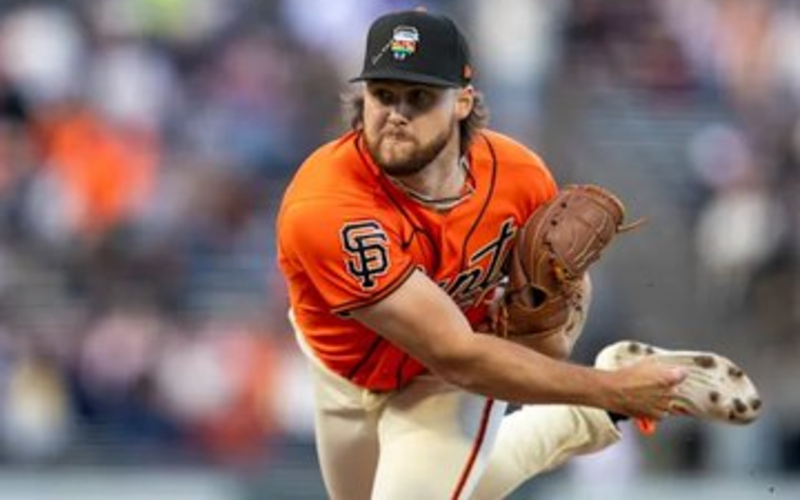
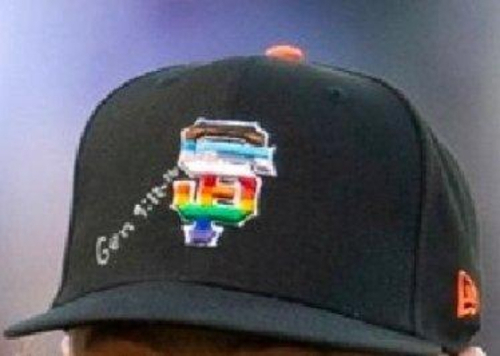
Major League Baseball, you might say, pitched high and inside when it expressed displeasure with three San Francisco Giants players, all pitchers, who wrote Bible verses on their team-issued “Pride Night” caps during the annual game set aside to celebrate the LGBTQ lifestyle.
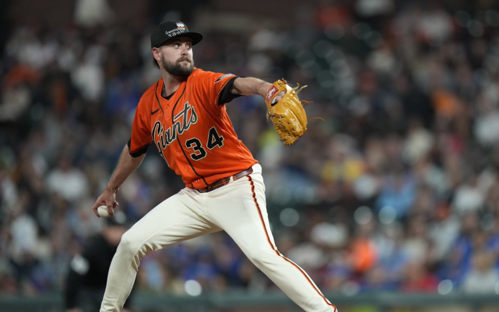
Landen Roupp, who started the game, and teammates J.T. Brubaker (pictured below) and Ryan Walker each wrote “Genesis 9:12-16” on their caps near the special rainbow imagery — some of it overlapping — where regular Giants black caps feature an orange interlocking SF.
 The passage shares the real story of the rainbow, God’s promise following the Great Flood that he will never again destroy the earth’s life with water.
In response, MLB issued a statement saying, “The writing on the cap violates our rules and consistent with normal practice we have warned the players about future violations.”
A second statement, issued Tuesday, was necessary for MLB to clearly communicate its intended message.
“To be clear, this routine verbal warning not to wear the hat in future games is not disciplinary and had absolutely nothing to do with the content of the message," MLB said.
However, the very nature of a warning implies future disciplinary action for repeat rules violations. So the message to the offending Giants players seemed pretty clear: “Back off.”
That’s certainly how Sen. Josh Hawley interpreted MLB messaging.
The Missouri Republican responded with his own warning Tuesday, reminding MLB of its privileged exemption from federal antitrust laws.
 No other professional sports enjoy such an exemption, Hawley wrote in his letter to MLB Commissioner Robert Manfred.
“My concern is sharpened by the singular legal position that Major League Baseball occupies. Alone among America’s professional sports leagues, baseball enjoys a sweeping, judicially manufactured exemption from the federal antitrust laws — a privilege the Senate Judiciary Committee has examined with bipartisan skepticism in recent years,” Hawley said.
Any league that benefits from such an “extraordinary dispensation” owes the public a similar measure of accountability, he wrote.
While MLB prevents players from presenting their own messaging on uniforms, the league has no qualms with pushing political viewpoints at the expense of its players.
It’s reasonable to conclude that while Roupp, Brubaker and Walker chose to write Scripture on their caps, and a fourth player, pitcher Sam Hentges chose not to wear the cap, other players might choose to begrudgingly wear the cap to avoid the backlash the others are facing now.
“In 2020, MLB itself turned its uniforms and field into a billboard for political and social messages. It created jersey patches reading ‘Black Lives Matter ‘and ‘United for Change.’ It authorized ‘BLM’ to be stenciled onto pitching mounds,” Hawley wrote. “And it suspended its own equipment rules so that players could display progressive political slogans on their cleats.”
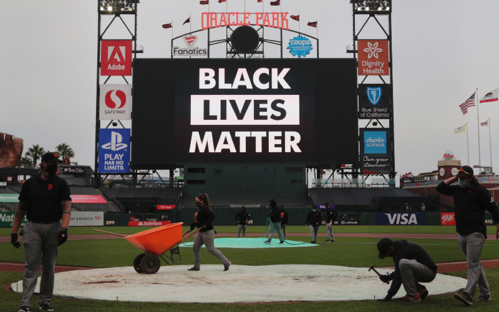 During that summer, following the death of George Floyd while police attempted to take him into custody in Minneapolis, Minnesota, MLB went beyond tolerating speech to designing and promoting speech, Hawley said.
“It shoehorned social and political messages into the game broadcast to millions of Americans,” he said.
Hawley, whose state features MLB clubs in St. Louis and Kansas City, noted that the Giants’ Pride caps represent the second time this summer MLB representatives have sought to block Christian expression.
Sean Hudson, the now-former director of community relations for the Washington Nationals, was recorded on hidden camera admitting the team avoided using pitcher Trevor Williams in promotional materials. It did so because Williams, a Catholic, had publicly criticized the Los Angeles Dodgers for honoring the Sisters of Perpetual Indulgence, a drag group that mocks Catholic nuns.
The Nationals denied Hudson’s claims yet dismissed him on May 29 following widespread backlash and calls for a Department of Justice investigation into alleged religious discrimination.
In his letter Hawley requested:
* A complete copy of the uniform regulation under which the Giants pitchers were warned, together with any internal guidance governing writing, markings or symbols on player apparel and equipment.
* A list of every instance over the past five seasons in which the league warned, fined or other disciplined a player or club under that regulation, identifying in each case the message at issue and the action taken by the league.
 * Any league or club policy, communication, or practice concerning the inclusion or exclusion of players from team-controlled media or promotion on the basis of their religious expression.
* Any policy, directive or expectation — formal or informal — governing whether players are required, encouraged or expected to wear “Pride Night” caps, jerseys or other themed apparel and whether players who decline to do so face any consequences beyond the league’s written rules, including playing time, roster or assignment decisions, club media promotion or standing within the organization.
*All approvals, authorizations or directives by which the league created, permitted or arranged the display of “Black Lives Matter” or “United for Change,” or comparable messaging on jerseys, mounds or equipment and any guidance by which the league relaxed its equipment rules to allow players to display social or political messages.
“The freedom to live out one’s faith does not end at the ballpark gate. Americans of every creed are entitled to confidence that the institutions of our national pastime will not single out religious expression for punishment while celebrating messages of the league’s own choosing,” Hawley wrote.