


Promotional material for the new Women's Pro Baseball League (WPBL) describes it in this way on its inaugural opening day over the weekend:
"For generations, the flame of women's baseball has been carried by those who believed, by those who fought, by those who never stopped showing up. Tonight, we reignite that flame as it burns brighter than ever all over the world."
Based on viewership numbers, fans have historically preferred men's sports. But many researchers and advocates argue that the lack of investment and exposure played a major role in limiting women's sports' popularity.
Women's sports have been gaining more publicity in recent years. According to the 2025 Nielsen data, 46 billion viewing minutes of women's sports were consumed in the U.S during 2025.
This is not only due to leagues like the WNBA and NCAA Women's Basketball gaining record-high viewership numbers, but also due to more professional sports leagues like the WPBL, Major League Volleyball, and the NFL's involvement in supporting Girls Flag Football.
Also, Caitlin Clark, Simone Biles, and Alex Morgan have helped give young female athletes high-profile role models, a level of visibility that was not as prevalent in previous years.
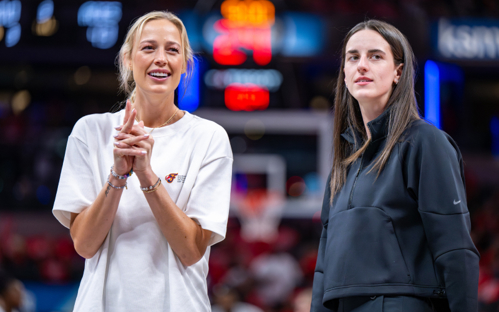 Critics have said in the past that women's sports are not as fun to watch as their male counterparts. However, many moments such as Clark's March Madness run, Biles' return at the 2024 Olympics, and the U.S. Women's National Soccer Team gold medal at those Olympics left viewers feeling captivated and interested in watching more.
From promotion to protection
Macy Petty Charles, legislative strategist at Concerned Women for America (CWA), says, "We shouldn't just watch women's sports because we want to support women, but watch women's sports because they're fun."
Noting the chaos surrounding Indiana Fever star Sophie Cunningham, who recently made a statement supporting banning boys from girls' sports, the CWA is calling on the Women's National Basketball Association (WNBA) to protect its athletes.
A pro-Cunningham rally took place Sunday outside the Target Center in downtown Minneapolis before the Indiana Fever faced the Minnesota Lynx. The Lynx's head coach, Cheryl Reeve, wore a "Trans Kids Belong" shirt ahead of the game and said, "Every kid has a right to sports."
The event led to clashes between Cunningham supporters and a small group of people who backed Reeve's message.
With additional pro-Cunningham rallies planned as the WNBA season continues, CWA says the league needs to adapt a policy to protect fairness in women's sports and only allow women to play in the league.

"I don't want another statement from them," Charles tells AFN. "I want them to have a policy change that would back it up and show that they really do stand with female athletes, and that the WNBA is around for good and not just the next NBA."
She points out that the WNBA was created to give women more opportunities, but the league has shown a "disappointing" lack of support for its players.
She thinks the courage of outspoken female athletes like Cunningham has really helped move the needle.
"I have to credit a lot to female athletes," Charles says. "They're the ones speaking up and turning the tide and gaining public attention, because it's certainly not the governing officials who are eager to protect women's sports."


