In a first-ever event that occurred in Shenzhen, China, President Donald Trump sat down with Vladimir Putin and Xi Jinping for a trilateral meeting of the world leaders.
The three-way meeting lasted roughly 90 minutes after about a two-hour delay, according to press reports.
The three world leaders met after President Trump met with each of them one-on-one earlier in the day.
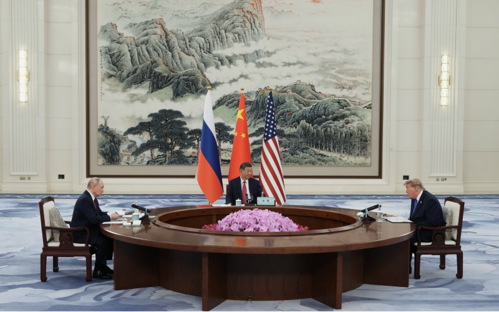 Trump, Xi, and Putin were holding face-to-face discussions on the sidelines of the APEC Summit, the annual meeting of 21 nations who are part of the Asia-Pacific Economic Cooperation.
Hours before the meeting occurred, the White House told American Family News a main topic Trump planned to raise with both world leaders is nuclear weapons,
The U.S. president plans to discuss the reduction of nuclear weapons, “whose proliferation President Trump believes is very dangerous,” a White House official said.
After the meeting, Xi called it positive, constructive and fruitful, while Putin described the trilateral talks as open and candid, calling the format “useful and substantive," the Associated Press reported.
“It is a serious collaborative work,” he said in response to a question about whether this format is something other than just an image of three leaders coming together.
Third carrier reaches Middle East waters
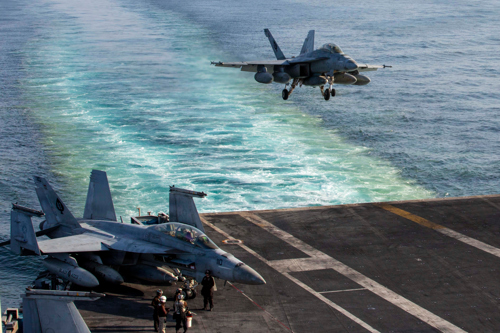
Meanwhile, U.S Central Command announced Monday the USS Theodore Roosevelt is now under its command after transiting the Indian Ocean a day earlier.
The vessel, which departed San Diego in September, has joined fellow carriers USS George H.W. Bush and USS George Washington.
All three carriers are really a “strike force” of other warships, as well as lethal aircraft and U.S. Marines, that form a naval blockade of Iran that is blocking exports of crude oil that finance the regime.
 The naval blockade comes after "Operation Epic Fury" decimated Iran's military, and killed numerous political and military leaders, including Supreme Leader Ayatollah Khamenei (pictured at right).
The military attack failed to topple the Islamic regime that is led by the IRGC, Islamic Revolutionary Guard Corps, which is still clinging to power.
China imports approximately 12% of its oil from Iran, and the two countries are military and business partners after signing a 25-year cooperation agreement in 2021.
Reacting to the Roosevelt arriving in the region, U.S. Rep. Marlin Stutzman (R-Indiana) told “Washington Watch” he believes the arrival of a third aircraft carrier is a signal the Trump administration supports Israel even after Benjamin Netanyahu, the longtime prime minister, has lost political power in the Knesset.
Rep. Stutzman is an outspoken supporter of the State of Israel.
“I think what President Trump is signaling is that the United States is standing with Israel,” Stutzman observed, “that we're going to be sure that there's no further attacks on the nation of Israel.”
That optimistic view linking White House support for Israel with the Roosevelt is challenged by the Roosevelt’s announced departure in late August. Israel’s parliamentary elections were held Oct. 27.
 Another reason to doubt the Trump administration is sending the Roosevelt to help its Middle East ally is President Trump’s surprise announcement, on Election Day, the U.S. is ending $4 billion in annual military aid to Israel and its IDF.
Back in China, the country's longtime ruler greeted Trump on the tarmac of Shenzhen Bao'an International Airport. That unusual gesture was seen as diplomatic goodwill after the U.S. president met the Chinese leader when he arrived in Washington, D.C. earlier this year.
"China is a nation that values courtesy and has a tradition of returning goodwill with goodwill," a report in China's state newspaper, Xinhua, stated.
In a statement to AFN, White House spokesperson Olivia Wales said, “Under President Trump’s leadership, U.S.-China relations have been refocused on what matters most — rebuilding the safety, security, and prosperity of Americans.”